
Half a point sounds like nothing. In a sport where final scores regularly exceed 100, what difference could 0.5 make? Over a single bet, probably none. Over a season of 200 bets, it is the difference between profit and loss. I tracked my results across two NBA seasons — one where I placed every bet at whichever bookmaker I happened to have open, and one where I checked at least three operators before placing each wager. The line-shopping season produced 2.3% higher ROI on virtually identical picks. Half a point, multiplied by hundreds of bets, is worth more than any single insight I have ever had about a basketball game.
The Half-Point Edge: Compounding Value Across Hundreds of Handicap Bets
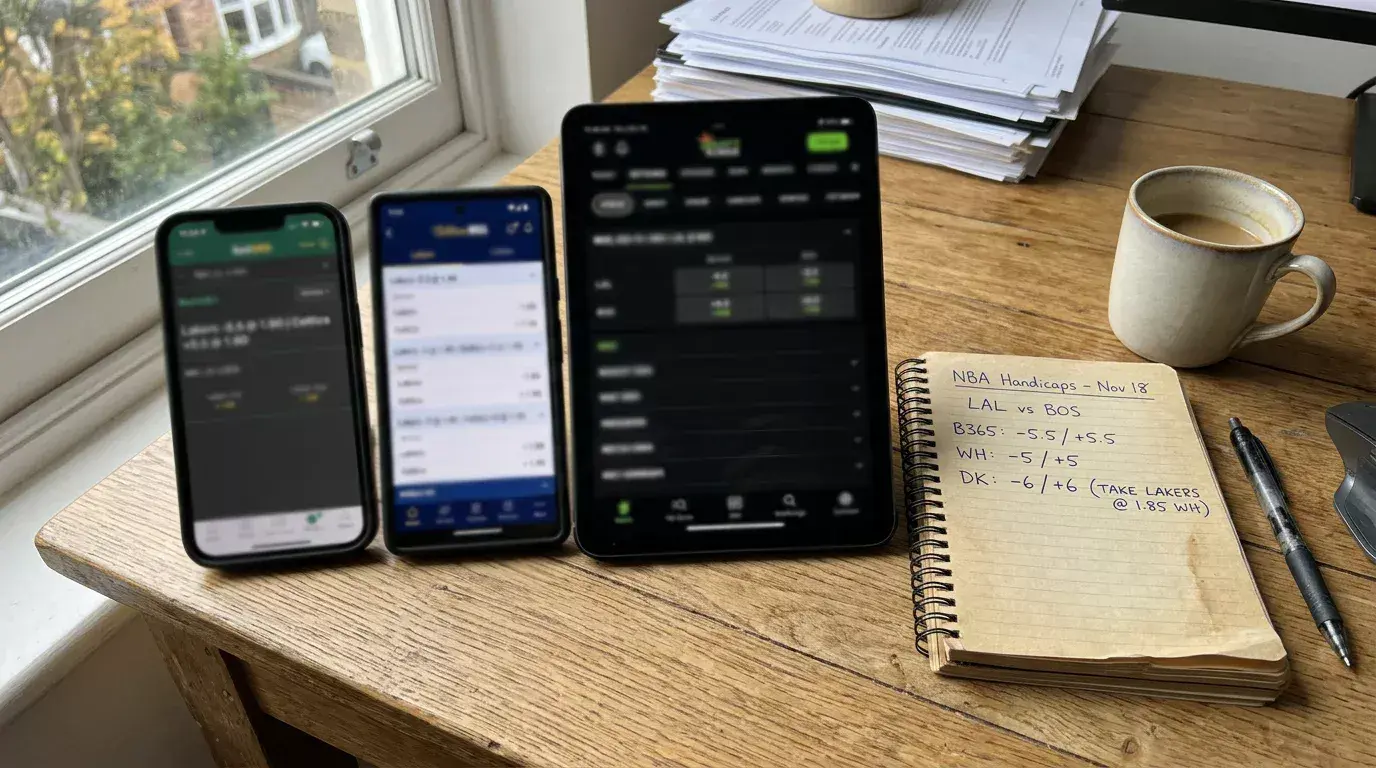
The mechanics are simple. If the spread at Operator A is -7.5 and Operator B has -7, the difference is half a point. In a game decided by exactly seven, that half-point is the difference between a loss and a push (or, if Operator B has -6.5, between a loss and a win). Over a season, a handful of games will land exactly on the margin where your line-shopping saved or cost you the bet. Those marginal results compound into the gap between a profitable season and a break-even one.
William Hill captures 37.83% of PPC clicks in UK sports betting, with Bet365 at 16.2%. These are the operators where most punters begin, and many never look further. The result is that a significant portion of UK basketball bettors are taking whatever line their primary operator offers, without checking whether a better number exists elsewhere. The bookmaker who attracts the most traffic is not necessarily the one offering the best spread on any given game.
The key numbers in basketball — 3, 5, 7, and 10 — make line shopping even more valuable than it is in football. Because certain margins of victory cluster around these numbers (due to the structure of basketball scoring), getting the right side of a key number captures a disproportionate share of outcomes. Shopping from -7.5 to -7 is more valuable than shopping from -8.5 to -8, because the former crosses a key number and the latter does not. Understanding which half-points matter most allows you to prioritise your line-shopping effort on the games where the payoff is largest.
Tools, Odds Comparison Sites, and Best Times to Shop
Several free odds-comparison platforms aggregate basketball handicap lines from UK-licensed bookmakers, displaying the spreads and odds side by side. These tools eliminate the need to log into each operator individually and check the numbers manually. You enter the game, see all available lines at a glance, and identify which operator is offering the best number on the side you want to bet.
Flutter Entertainment — the parent company of Sky Bet and Paddy Power — generated $15.91 billion in revenue in 2025, growing 17% year on year. Part of that growth comes from the sheer volume of bets placed by punters who do not comparison-shop. Using an odds-comparison tool is the simplest way to ensure you are not systematically overpaying for spreads, and the time investment — two minutes per game — pays for itself many times over across a season.
Timing matters. Lines are sharpest — meaning closest to the true probability — near tip-off, after all available information has been priced in. But the best time to shop is not necessarily at tip-off. Early lines, posted 12 to 24 hours before the game, often show the widest variation between operators, because different bookmakers respond to early money at different speeds. If you shop early and find a half-point or full-point advantage at one operator, that advantage may disappear by tip-off as the lines converge. The trade-off is familiar: shop early for the best number but accept the risk of late-breaking news, or shop late for maximum information but accept tighter lines with less variation.
A Practical Line-Shopping Workflow for UK Punters
My workflow has three steps, and it takes less than five minutes per game. First, I identify the games I want to bet based on my analysis — this happens before any line is checked, because the analysis should drive the bet selection, not the available number. Second, I open the odds-comparison tool and find the best available spread on my chosen side for each game. Third, I place the bet at the operator offering the best number, regardless of which account I used last or which operator I prefer for other reasons. Loyalty to a single bookmaker is a luxury that costs real money in spread betting.
Having accounts at a minimum of three UK-licensed operators is the prerequisite. Five is better. The marginal benefit of each additional account decreases — the fourth account adds less value than the third, and the sixth adds less than the fifth — but the first three accounts provide the bulk of the benefit. Keep modest balances at each, top up as needed, and treat the portfolio of accounts as a single tool rather than competing alternatives.
Be aware that aggressive line-shopping can attract attention from bookmakers. Operators monitor accounts that consistently take the best available number, because those accounts tend to be unprofitable for the book. If your account is restricted at one operator — stakes limited or certain markets removed — do not panic. It is a common experience among profitable handicap bettors, and it reinforces the importance of maintaining multiple accounts. Losing access to one operator out of five is an inconvenience; losing access to your only account is a problem.
One habit that accelerated my line-shopping was recording the line I got versus the closing line for every bet. This is effectively a closing-line-value log, and over time it reveals whether your shopping is capturing genuine value or simply finding lines that look different but close at the same number. If your average bet consistently beats the closing line by half a point or more, your line-shopping is working. If it does not, you may be shopping at the wrong times or comparing too few operators. The UK bookmakers guide covers which operators tend to post basketball lines earliest and which offer the widest range of alternative spreads, both of which are relevant to effective line-shopping.