
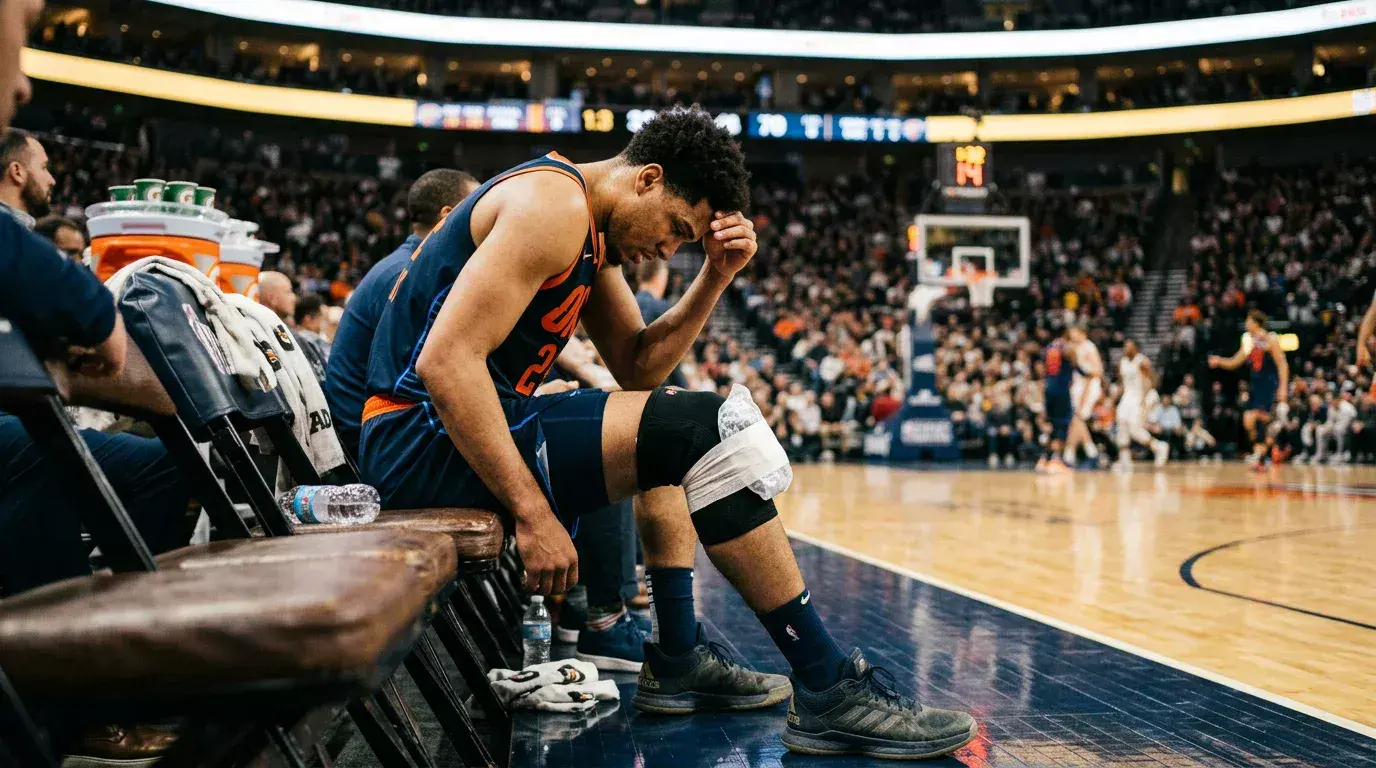
In February 2024, I placed a spread bet on a Western Conference favourite three hours before tip-off. The line was -8.5, and my analysis supported it. Ninety minutes later, the team’s franchise player was listed as out with a knee issue, and the line cratered to -3. I was stuck with -8.5 on a team missing the player who generated a third of their offence. The bet lost by a mile. Since that evening, I have built a rigid process around injury news — and it starts with understanding exactly how much a single player is worth to the spread.
Star Player Value: Calculating Injury Impact on Bookmaker Point Spreads
Not all injuries are equal, and not all players move the line the same way. A star who handles 30-40% of a team’s offensive production is not just a scorer — they are a decision-maker, a defensive focus point, and often the player whose gravity creates open shots for everyone else. When that player sits, the team does not just lose their points. They lose the spacing, the attention, and the offensive structure that their presence provides.
The spread adjustment for a top-tier absence typically ranges from three to six points, depending on the player’s role and the quality of the replacement. When Nikola Jokic misses a game, Denver’s line moves differently than when a team’s fourth-best player sits out. The market is reasonably efficient at pricing star absences, but it is less precise with secondary players whose impact is harder to quantify.
Oklahoma City Thunder led the NBA in 2025-26 with a point differential of +11.29 per game. That figure represents the full squad’s output. Remove their primary ball-handler and the differential drops — but by how much? That is the question the bookmaker answers when adjusting the line, and it is the question you need to answer independently to evaluate whether the adjusted line is correct, too generous, or too tight.
My approach is to track each team’s point differential with and without their top three players across the current season. Most advanced stats sites publish “on-off” splits that show how many points per 100 possessions a team gains or loses with a specific player on the floor. Translating that per-100 figure into a per-game spread adjustment is not a precise science, but it gives you a baseline. If the on-off data says a star is worth +8 points per 100 possessions and the average NBA game involves roughly 100 possessions per team, the spread adjustment should be in that ballpark. When the bookmaker moves the line by only four, you may have found value on the other side.
Beyond Stars: Depth, Role Players, and Cumulative Absences
The injury report does not just list one name. On a given night, a team might be missing a starting guard, a rotation wing, and a backup centre. Each individual absence moves the line modestly, but the cumulative effect can exceed the sum of the parts. A team missing three rotation players is not just short on talent — they are short on lineup versatility, forced to play combinations that have logged minimal minutes together.
I learned this lesson during a stretch in the 2022-23 season when a contending team lost two key defenders simultaneously. Each absence might have shifted the line by one or two points individually. Together, the defensive drop-off was closer to five points, because the replacements could not replicate the switching scheme that the two missing players anchored. The bookmaker moved the line by three. The market was underpricing the defensive interdependence.
Role-player injuries are the most commonly mispriced. The market efficiently adjusts for star absences because those are headline news. A backup point guard going down with a sprained ankle barely registers in the pre-game coverage, but if that player was the primary ball-handler for the second unit, the bench scoring can collapse. Track which bench players carry the highest usage rate for their unit, and flag any games where that player is listed as doubtful or out. The line adjustment, if there is one at all, is often too small.
Cumulative fatigue from playing short-handed over multiple games is another factor the market struggles with. A team that has played five straight games with a seven-man rotation may not show fatigue in the box score for Game 5, but by Game 6 or 7 the legs start to fail. The spread for the sixth game might reflect the team’s recent results — solid, competitive — without accounting for the fatigue cliff that is about to arrive. This is where your game-watching context adds value that no statistical model can replicate.
Timing Your Bet Around Injury News
The NBA mandates that teams submit an official injury report roughly ninety minutes before tip-off, with updates as late as thirty minutes prior. For UK punters, this means the final injury information often drops between 23:30 and 01:00 depending on the game’s start time. If you are placing pre-game bets earlier in the evening, you are betting blind on injury status — and the line you lock in may not reflect the reality at tip-off.
My rule is simple: do not bet a spread that depends on a specific player being available until that player is confirmed in or out. If you have done your analysis and identified value at the current line, but the value evaporates if the star sits, wait. The discipline costs you nothing. The premature bet can cost you the full stake.
There is a countervailing opportunity here too. When injury news breaks and the line moves sharply, the initial adjustment can overshoot. The market panics, the line swings three or four points, and then settles back by a point or two as sharper bettors step in on the adjusted number. If you are watching for the news and can act quickly, the post-announcement line in the first fifteen minutes is sometimes more favourable than the line that settles an hour later. Speed matters in this window — and having accounts with multiple UK bookmakers gives you the widest view of which operator has adjusted fastest and which is lagging.
The broader lesson connects to a process you can build into every betting day. Check the injury report as soon as it publishes. Compare the line before and after the news. Evaluate whether the adjustment matches your independent estimate of the player’s spread value. If the bookmaker has overreacted, bet into the overreaction. If they have underreacted, bet the other side. And if the adjustment looks fair, move on to the next game. Injury analysis is not about predicting who gets hurt — it is about pricing the impact correctly when they do. For more on how NBA spread trends and season data shape the backdrop for these decisions, the league-level guide adds context that individual-game injury analysis cannot provide alone.