

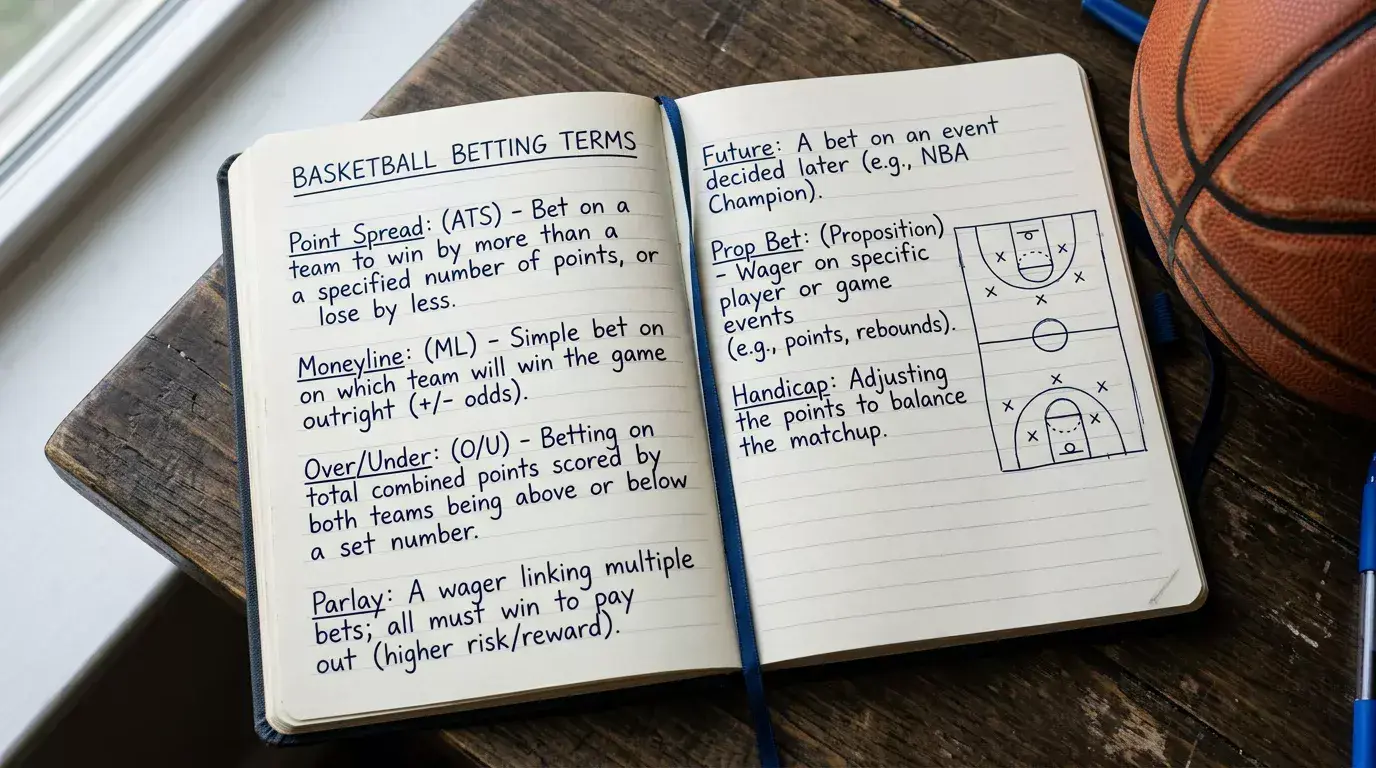
I spent my first three months reading basketball betting forums without understanding half the vocabulary. Someone would post “took the dog +6.5, covered easy, now 14-9 ATS on unders this month” and I would nod along as if that sentence made sense. It did not. The language of handicap betting is dense, borrowed from American sportsbook culture, and rarely explained for UK punters who grew up with football accumulators and fractional odds. This glossary exists because I wish someone had handed it to me before I started pretending I knew what “steam move” meant.
A–G Glossary: Defining Against the Spread (ATS) and Betting Terms
Against the Spread (ATS) — a team’s record when the point spread is factored in, rather than their straight-up win-loss record. A team can be 40-42 on the season but 48-34 ATS, meaning they covered the spread more often than not. ATS records are the primary performance metric for handicap bettors because they measure how well a team performs relative to expectations, not just whether they win.
Alternative Line — a handicap line that differs from the standard spread offered by the bookmaker. If the standard line is -7.5, alternative lines might include -5.5 (at shorter odds) or -9.5 (at longer odds). Buying or selling points through alternative lines lets you adjust the risk-reward balance on a specific game.
Asian Handicap — a handicap system that uses quarter-point increments (0.25, 0.75) and splits your stake across two adjacent lines. Originally developed for football betting in Asia, the format eliminates the possibility of a push and creates more nuanced risk profiles than standard Western spreads.
Closing Line — the final spread number available before tip-off. The closing line is widely considered the most accurate reflection of a game’s true probability, because it incorporates all available information and money. Consistently beating the closing line — placing bets at numbers better than the final line — is one of the strongest indicators of long-term profitability.
Cover (the Spread) — to win a handicap bet. If you back a team at -7.5 and they win by 8 or more, they covered. If you back the underdog at +7.5 and they lose by 7 or fewer (or win outright), they also covered. The margin of victory relative to the spread is what matters, not the outcome of the game itself.
Dog — shorthand for underdog, the team receiving points on the spread. A team listed at +5.5 is “the dog” or “getting five and a half.” In casual conversation, bettors often say “I took the dog” to mean they backed the team receiving the handicap advantage.
Favourite — the team giving points on the spread, indicated by a minus sign. A -6 favourite must win by more than six points for a handicap bet on them to pay out. The bigger the number, the larger the expected margin of victory.
Garbage Time — the final minutes of a game where the outcome is already decided and starters are pulled from the floor. Garbage-time scoring by bench players can dramatically affect whether a spread is covered, even though the competitive portion of the game is over. A team leading by 20 with four minutes left might surrender a 12-0 run to the opponent’s reserves, turning a comfortable cover into a loss against the number.
H–P: Handicap to Push
Handicap — the points advantage or disadvantage applied to a team for betting purposes. In basketball, handicaps are synonymous with point spreads. The term “handicap” is more common in UK and European markets, while “spread” dominates American usage. They mean the same thing.
Juice — the commission built into the odds by the bookmaker, also called vigorish or vig. On a standard spread bet with even chances, you might see odds of 10/11 (or 1.91 in decimal) rather than even money. That gap between the true probability and the offered odds is the juice — the bookmaker’s margin on every wager. NBA home teams win roughly 60% of their games, translating to about three points of built-in home-court advantage in the spread, but the juice ensures the bookmaker profits regardless of which side the public favours.
Line — the spread number itself. “The line is -7.5” means the favourite is giving seven and a half points. “The line moved from -7 to -8” means the spread widened, indicating money or information shifting toward the favourite.
Line Movement — a change in the spread between the opening number and the closing number. Line movement is driven by betting volume (public money), sharp action (professional bettors), and new information (injuries, lineup changes). Tracking how and when lines move is a core analytical skill for handicap bettors.
Moneyline — a bet on which team wins the game outright, without any point spread. The moneyline and the handicap are the two primary markets for basketball betting. On heavy favourites, the moneyline offers poor value because the odds are extremely short; the handicap market provides more competitive pricing by equalising the contest through points.
Opening Line — the first spread number posted by the bookmaker, typically released 12-24 hours before tip-off for NBA games. The opening line reflects the bookmaker’s initial assessment, based on power ratings and internal models, before public and sharp money begins to shape the number.
Pick ’em (PK) — a game where neither team is favoured on the spread. The line is effectively 0, meaning you are betting on which team wins without any handicap adjustment. Pick ’em games are rare in basketball but occur when two teams are judged to be perfectly equal after home-court advantage is factored in.
Point Spread — the number of points by which the favourite is expected to win, as determined by the bookmaker. In practice, “point spread” and “handicap” are interchangeable terms. A -5.5 point spread means the favourite is expected to win by approximately five to six points.
Push — a result where the final margin of victory lands exactly on the spread number, resulting in a voided bet. If the spread is -7 and the favourite wins by exactly seven, neither side wins or loses — stakes are returned. Half-point lines (like -7.5) eliminate the possibility of a push.
Q–Z: Quarter-Point Line to Zig-Zag Theory
Quarter-Point Line — a spread that uses 0.25 or 0.75 increments, common in Asian handicap markets. A line of -6.25 splits your stake: half is placed at -6 and half at -6.5. If the result falls between the two numbers, you win one half and push the other. Quarter-point lines add precision but require understanding split-stake mechanics.
Sharp Money — wagers placed by professional bettors or syndicates whose action moves lines. Sharp money is distinguished from public (or “square”) money by its timing, size, and impact on the spread. When the line moves against the side receiving the majority of bets, sharp money on the other side is usually the cause.
Square Money — bets placed by recreational bettors, also called “public money.” Square money tends to favour favourites, home teams, and high-profile franchises. Bookmakers factor public betting patterns into their line-setting, and contrarian bettors sometimes profit by fading — betting against — the public side.
Steam Move — a sudden, dramatic shift in the spread caused by coordinated sharp action across multiple bookmakers simultaneously. A steam move might see a line jump from -5 to -7 within minutes. These moves signal strong professional conviction and are closely tracked by line-movement analysts.
Vig (Vigorish) — another term for juice, the bookmaker’s commission. On a standard -110 American odds line (equivalent to roughly 10/11 fractional), the vig is approximately 4.55%. Over hundreds of bets, the vig represents the structural headwind that every bettor must overcome to be profitable. The break-even win rate on standard vig is approximately 52.4%.
Zig-Zag Theory — a playoff betting strategy that advocates backing the team that lost the previous game in a series, on the theory that teams facing elimination or seeking to avoid a deficit play with greater intensity. Since 2014, first-round playoff favourites of 8.5 points or more have gone 62-41 ATS — a 60.2% cover rate — which offers partial evidence for the theory’s underlying logic, though it does not prove the zig-zag pattern specifically.
If any of these terms are still unclear in context, the beginners’ guide to NBA handicap betting walks through several of them with worked examples and step-by-step scenarios.