

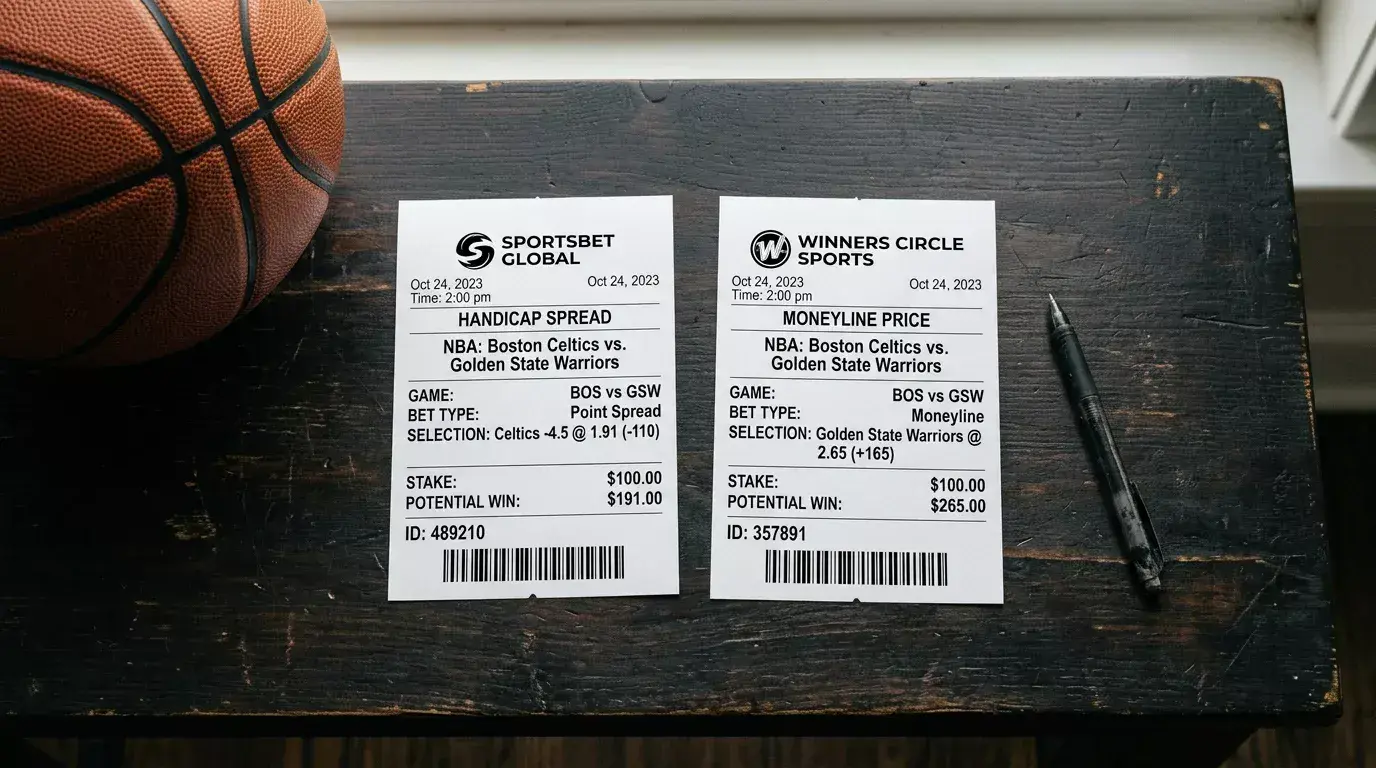
A friend once told me he never touches handicap bets because “picking the winner should be enough.” He backed a -400 moneyline favourite that night — risking 40 pounds to win 10 — and the team duly won by nineteen points. He got his tenner. I took the same team at -8.5 on the spread at 10/11 and collected nearly the same return on a fraction of the risk. That evening neatly captures the core tension between these two markets: the moneyline rewards certainty, while the handicap rewards precision.
Both markets ask you to have a view on the same game, yet they measure different things and expose you to different risk profiles. Choosing between them is not a matter of temperament — it is a matter of where the value sits on any given fixture. Here is how I break that decision down after eight years of staring at basketball lines.
Payout Structures Compared: Handicap Point Spreads vs Moneyline Odds
Every Tuesday evening during the NBA season, I pull up the same game on two tabs: the handicap market and the moneyline market. The difference in pricing tells a story. Home teams in the NBA win around 60% of their games, and that baseline translates into roughly a three-point home-court edge baked into the spread. On the moneyline side, that same edge produces a much wider price gap between favourite and underdog.
Take a game where the favourite is listed at -7.5 on the spread. The handicap price on both sides will sit close to even money — typically 10/11 or 5/6 in fractional terms. The bookmaker is saying “we think this game is a coin flip once we adjust for the expected margin.” The moneyline on the same favourite, however, might be 1/4 or shorter. You are laying four pounds to win one, because the bookmaker is pricing in the high probability that the better team wins outright, regardless of margin.
The arithmetic is stark. On the spread at 10/11, a ten-pound stake returns 19.09 pounds if your side covers. On the moneyline at 1/4, that same ten-pound stake returns just 12.50 pounds. The handicap market compresses the payout range — you get close to even money on both sides — while the moneyline stretches it, making favourites cheap and underdogs expensive. For a bettor with a fixed bankroll, the spread offers more efficient use of capital when you believe the favourite will win comfortably.
Where the moneyline earns its keep is on the underdog side. A +7.5 underdog on the spread still pays roughly 10/11, but the same team on the moneyline might be 3/1 or higher. If you genuinely believe the underdog wins outright — not just covers, but wins — the moneyline payout is far more rewarding. The trade-off is that you lose the cushion the handicap provides.
Risk and Variance: What Each Market Costs You
I lost fourteen consecutive moneyline bets on NBA underdogs during the 2022-23 season. Every single pick was a team I thought had a genuine chance to win outright. Several of them did cover the spread — they just did not win the game. That losing streak taught me something about variance that no spreadsheet could: the moneyline on underdogs is a high-variance play, and you need a stomach for long losing runs even when your analysis is sound.
Handicap betting compresses that variance. Because the spread adjusts the expected margin to roughly 50/50, your win rate over a large sample should cluster around 50% if you are breaking even (before the vig). The swings are smaller, the drawdowns shorter, and the emotional toll lighter. You will still have losing weeks, but a ten-bet losing streak on spreads is rarer than on underdog moneylines simply because the probability of each individual bet is closer to a coin flip.
Moneyline favourites carry the opposite risk profile: high win rate, low return per bet, and catastrophic damage when the favourite loses. One upset wipes out four or five successful favourite bets at short prices. I have seen recreational bettors build a lovely-looking win percentage — 70%, 75% — and still lose money over a season because the losing bets were priced so much more steeply than the winners.
The vig hits differently in each market too. On the spread, the bookmaker’s margin is transparent: that gap between 10/11 and evens is the cost. On the moneyline, the vig is baked into the favourite-underdog price gap. It is harder to spot, which means it is easier to overpay. Always compare the implied probability of both sides; if they sum to significantly more than 100%, the bookmaker is taking a larger cut than usual.
Scenarios Where One Market Beats the Other
There is a line I return to constantly when I evaluate a game: “We are betting numbers, not teams.” Tony George, a veteran sports handicapper, uses that phrase to remind bettors that the spread is a price, and prices can be wrong. The same logic applies to the choice between markets — you are not picking a favourite format, you are picking the one where the number is more in your favour.
Use the handicap when the favourite is strong but the moneyline is too short to justify the risk. If a team is -3.5 on the spread and 1/3 on the moneyline, the spread gives you a near-even-money bet on a team you expect to win by a comfortable margin. The moneyline asks you to risk three pounds for every one pound of profit — and one upset ruins the whole week.
Use the moneyline when you spot a live underdog that the market has mispriced. Late-season games where a top team rests its starters, or a back-to-back where the favourite is on the second night of a road trip, can produce genuine upset value. In those spots, the moneyline underdog at 2/1 or 5/2 pays better than the spread, because you are being rewarded for the additional risk of needing an outright win.
Use the handicap when you want to back an underdog but are not confident they win outright. The spread gives you a cushion — +6.5 means they can lose by six and you still cash. The moneyline on the same underdog offers a bigger payout but demands the outright win. If your analysis says “close game, could go either way, but the favourite probably edges it,” the underdog spread is the sharper play.
There are also games where neither market offers value. If the spread looks right and the moneyline is priced efficiently, the best move is no move at all. Discipline in market selection is as important as discipline in game selection, and learning when to sit out is a skill that a structured handicap strategy can help you develop.
Matching the Market to Your Betting Identity
After years of toggling between both markets, I have settled into a pattern: roughly 80% of my basketball bets go on the spread, and 20% on the moneyline — almost exclusively underdog moneylines where I see genuine upset potential. That split is not a rule. It is a reflection of where I find the most consistent value given my analysis style, which leans heavily on margin-of-victory data and situational factors rather than outright winner prediction.
Your split will look different, and it should. The important thing is to treat the market choice as part of your analysis, not a default setting. Every game presents two questions: which side, and which market. Answer both before you open the bet slip, and you will already be ahead of the majority of recreational bettors who never consider the second question at all.