

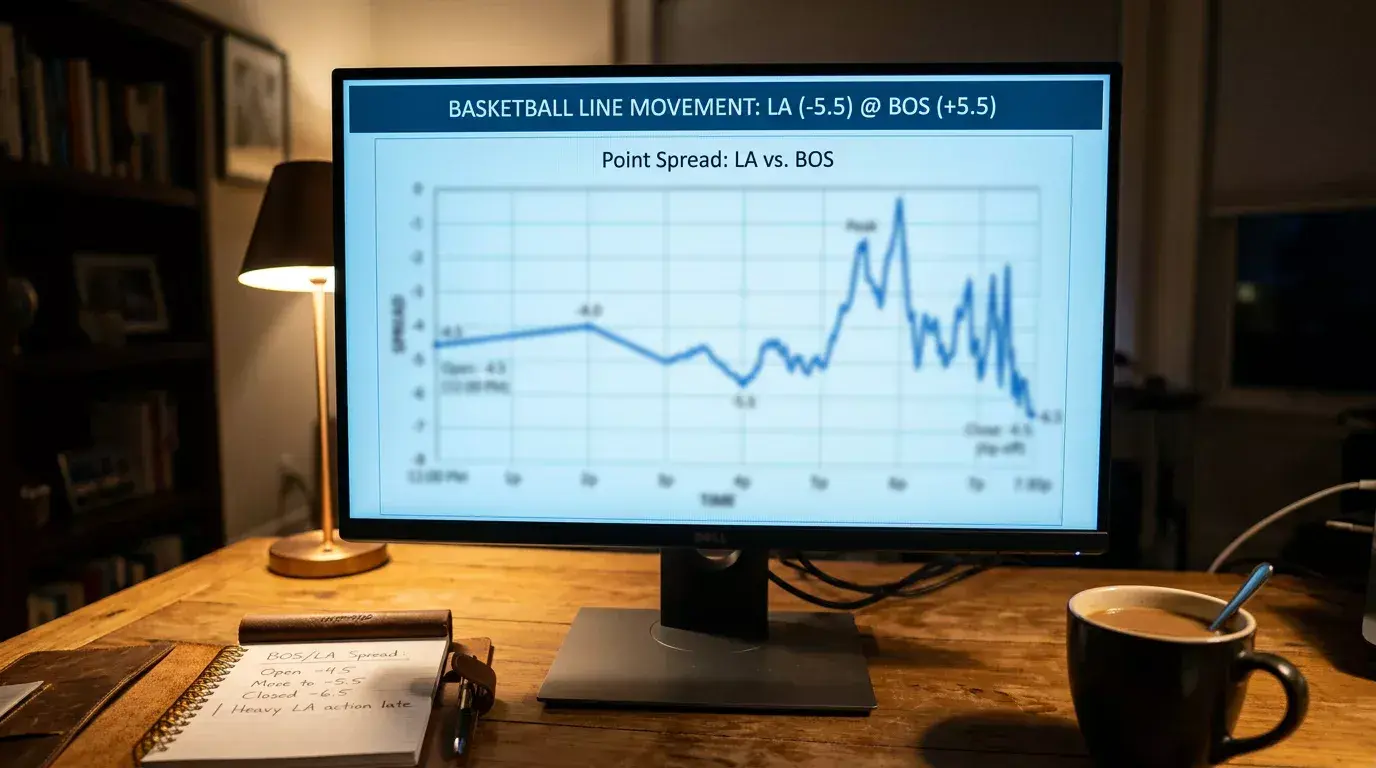
In my second season of basketball handicap betting, I noticed something that confused me. A game had 78% of public bets on the favourite, but the line was moving toward the underdog — from -6 to -5. The majority was backing one side, yet the number was shifting the other way. It made no sense until I learned about sharp money — the bets placed by professional bettors and syndicates whose wagers are large enough and informed enough to move lines against the weight of public opinion. Understanding sharp money did not make me a professional bettor. But it gave me a lens for reading line movement that I use on every game.
Reverse Line Movement: Identifying Sharp Money Signals on Handicap Markets
Reverse line movement occurs when the spread moves in the opposite direction from where the majority of bets are placed. If 75% of bets are on the favourite but the line moves from -7 to -6, something is overriding the public money — and that something is sharp action on the underdog. The bookmaker has received wagers from accounts they respect, accounts with a track record of profitability, and they have adjusted the line to reflect the information those bets carry.
Not all line movement is meaningful. Lines fluctuate throughout the day as bets come in, and a half-point shift in either direction is routine noise. What signals sharp money is direction against the public, combined with timing. Sharp action tends to arrive early — within hours of the line opening — because professionals aim to capture the best available number before the market adjusts. Public money arrives later, closer to tip-off, and often follows the narrative of the day: national television games attract heavier public action on favourites, star-driven teams draw casual bets regardless of the line.
William Hill accounts for 37.83% of PPC clicks in UK sports betting, with Bet365 at 16.2%. The betting patterns visible at these operators reflect public tendencies — the teams that attract the most recreational attention. When the line at these operators moves against the popular side, it is a stronger signal than the same movement at a smaller, sharp-oriented book, because it means the operator is willing to take on public liability in order to protect against informed action on the other side.
I track reverse line movement using a simple spreadsheet. For every NBA game, I record the opening line, the closing line, the direction of public betting (which side has the majority of bets), and whether the line moved with or against the public. Over a full season, the games with reverse line movement — where the line moved against the public side — have covered the spread at a higher rate than games where the line moved with the public. The edge is not enormous, but it is consistent, and consistency is what compounds over hundreds of bets.
Steam Moves and Syndicate Action
A steam move is the most dramatic form of sharp action. It occurs when a syndicate — a group of professional bettors operating in coordination — places simultaneous wagers at multiple bookmakers within minutes. The result is a sudden, sharp line movement that cascades across the market. A line might jump from -5 to -7 in under ten minutes, with every major operator adjusting in rapid succession.
Steam moves are rare on any individual game, but they happen several times per week across the full NBA slate. The challenge for UK punters is speed: by the time you notice a steam move, the line has already adjusted, and the value that the syndicates captured is gone. Chasing a steam move — betting the side that just moved, at the post-move number — is one of the most common mistakes in handicap betting, because the post-move line has already incorporated the information that the sharp money carried.
The more productive approach is to anticipate where steam might land. If your own analysis identifies a game where the line seems mispriced — where the standard spread diverges from your model by two or more points — and sharp money subsequently confirms your view by moving the line in the same direction, you have captured the value ahead of the syndicate. This is the ideal scenario: your independent analysis aligned with professional money, and you got a better number because you acted first.
Interpreting the Sharp-Public Betting Split
Several third-party services publish data showing the percentage of bets and the percentage of money on each side of a spread. The distinction between these two metrics is critical. Bet percentage tells you how many individual wagers are on each side — largely a reflection of public sentiment. Money percentage tells you where the actual pounds (or dollars) are concentrated, which gives more weight to large individual wagers from professional accounts.
The most interesting games are those where the bet percentage and money percentage point in opposite directions. If 80% of bets are on the favourite but only 45% of the money is on the favourite, it means a smaller number of large wagers — likely sharp — are concentrated on the underdog. This divergence is a red flag for the public side and a green flag for the sharp side. One veteran bookmaker interviewed by ESPN put it this way: you will always have bad actors, and you cannot eliminate the influence of informed money entirely, but the goal is to expose the information and let the market price it correctly rather than restricting what is offered.
For UK punters, accessing this data requires either subscribing to a US-based line-tracking service or following analysts who publish the splits on social media. The data is less readily available than in the American market, where multiple outlets compete to provide real-time bet-versus-money breakdowns. If you invest in one data source for basketball handicap betting, the sharp-public split is the most valuable single metric — more useful than any individual ATS record or seasonal trend.
The skill of reading sharp money is not about blindly following professionals. It is about understanding why the line is moving, whether the movement reflects genuine information or routine book-balancing, and whether the post-movement number still offers value from your perspective. For a deeper look at the mechanics behind the numbers, the guide to how bookmakers set basketball lines explains the full lifecycle from power ratings to closing line.