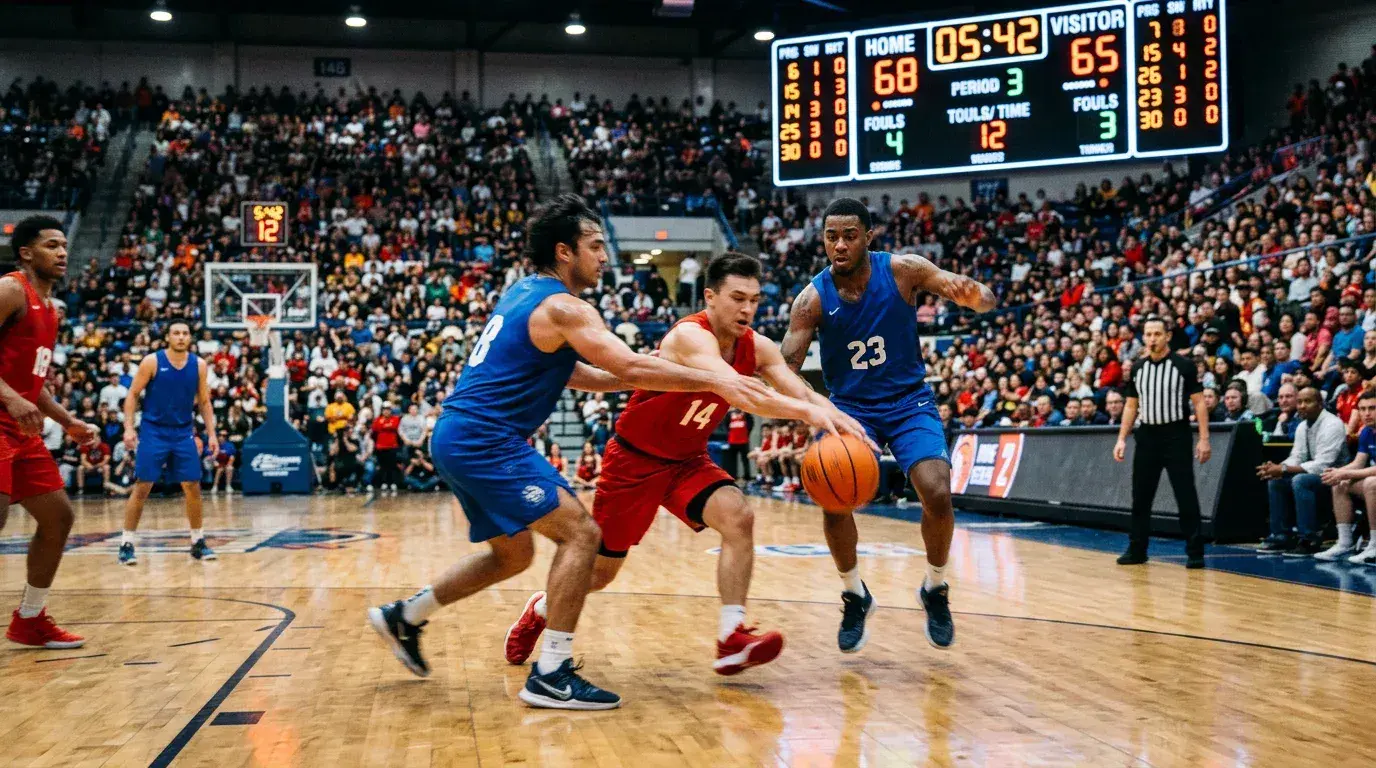


I came to basketball handicap betting from football. For years, I had placed Asian handicap bets on Premier League and Champions League matches, and I assumed the transition would be seamless — same concept, different sport. Within a month I had lost money on spreads that would have been inconceivable in football, including a game where the favourite won by 31 points and still failed to cover a 32.5-point line. Basketball operates on a different scale, and the habits that serve you well in football handicap betting can actively damage your results on the hardwood.
Scoring Volume Impact: Why Basketball Point Spreads Exceed Football Handicaps
The most obvious difference is the size of the numbers. In football, a -1.5 handicap is a significant ask — the favourite needs to win by two or more goals, which happens in a minority of matches. In basketball, -1.5 is barely a handicap at all. The average NBA game features a combined score of roughly 220 points across two teams, and the average margin of victory in the 2025-26 season reached +12.9 points — a historical record. A football match averaging 2.7 total goals and a basketball game averaging 220 total points exist on fundamentally different scoring scales, and the handicap markets reflect that.
What this means in practice is that basketball handicap lines routinely reach double digits. A -14.5 spread in football would be absurd — you would need the favourite to score fifteen more goals than the opponent. In basketball, -14.5 is a normal line when a top team hosts a weak one. This scoring volume creates a wider distribution of outcomes, which introduces both more risk and more opportunity for the handicap bettor. The spread can move by three or four points on a single injury report, something that rarely happens in football markets.
The scoring volume also affects how garbage time — the final minutes of a blowout — distorts results. In football, a team leading 4-0 in the 85th minute is unlikely to concede two quick goals from substitutes. In basketball, a team leading by 25 with four minutes remaining will pull their starters, and the opponent’s bench unit routinely cuts the deficit to 15 during meaningless possessions. That ten-point swing in garbage time can flip a spread result that looked decided five minutes earlier. Football handicap bettors are rarely ambushed by late-game noise at this scale.
Variance, Push Frequency, and Half-Point Lines
The standard deviation in NBA scoring differential during 2025-26 was 8.2 points per game — another historical record for the 30-team era. That number quantifies the variance: even when you correctly identify the better team, the actual margin of victory swings widely around the expected margin. In football, the variance is lower because fewer goals are scored and each goal has a larger impact on the final outcome. A single defensive error in football can determine the match; in basketball, a single turnover is a footnote.
This higher variance changes how you should think about pushes. In football, whole-number handicaps like -1 or -2 push relatively often because common scorelines cluster around those margins. In basketball, whole-number spreads like -7 or -10 push less frequently because the scoring distribution is more diffuse — the likelihood of landing exactly on any specific margin is lower when points come in ones, twos, and threes rather than whole goals.
Despite this, half-point lines are just as important in basketball as in football. The difference between -7 and -7.5 might seem trivial, but over a season of betting, that half-point converts a handful of pushes into wins or losses. Line shopping across bookmakers to find the half-point in your favour is a habit that transfers directly from football to basketball, and it remains one of the simplest ways to improve long-term returns in both sports.
Asian handicap quarter-point lines (like -6.25 or -6.75) work identically in basketball and football — your stake splits across two adjacent whole or half-point lines. The mechanics are sport-agnostic. What changes is the context: a quarter-point line in football might split the difference between a one-goal and two-goal margin, while in basketball it splits the difference between margins that are eight and nine points apart. The split-stake calculation is the same, but the probabilities behind it are not.
Which Football Handicap Habits Transfer and Which Don’t
Some habits transfer cleanly. Line shopping works in both sports. Bankroll discipline is universal. The principle of betting numbers rather than teams applies regardless of the ball shape. Tracking your ATS record and reviewing your results periodically is valuable whether you are betting on Manchester City or the Milwaukee Bucks. These are structural habits, not sport-specific skills, and they should follow you across any market you enter.
What does not transfer is the intuition for line sizes. In football, I developed a feel for when -1.5 was value and when it was too rich. That feel was calibrated to football’s scoring environment, and it was useless in basketball. A -7.5 spread in basketball requires a completely different calibration — one that accounts for pace, roster depth, back-to-back scheduling, and fourth-quarter dynamics that have no football equivalent. Building that calibration takes time, and there is no shortcut except watching games, tracking results, and accepting that your football instincts will mislead you for the first few months.
The other habit that does not transfer is relying on home advantage as a stable factor. In football, home advantage is well-documented and reasonably consistent across leagues. In basketball, the home-court edge varies dramatically between venues. Denver’s altitude advantage is worth more than most home-court effects in the entire Premier League. A flat assumption about home advantage in basketball will produce errors that would not occur in football.
For UK punters making the transition, the guide to Asian handicap in basketball explains how the format you already know from football adapts to basketball’s scoring environment, including the split-stake mechanics at quarter-point lines.