

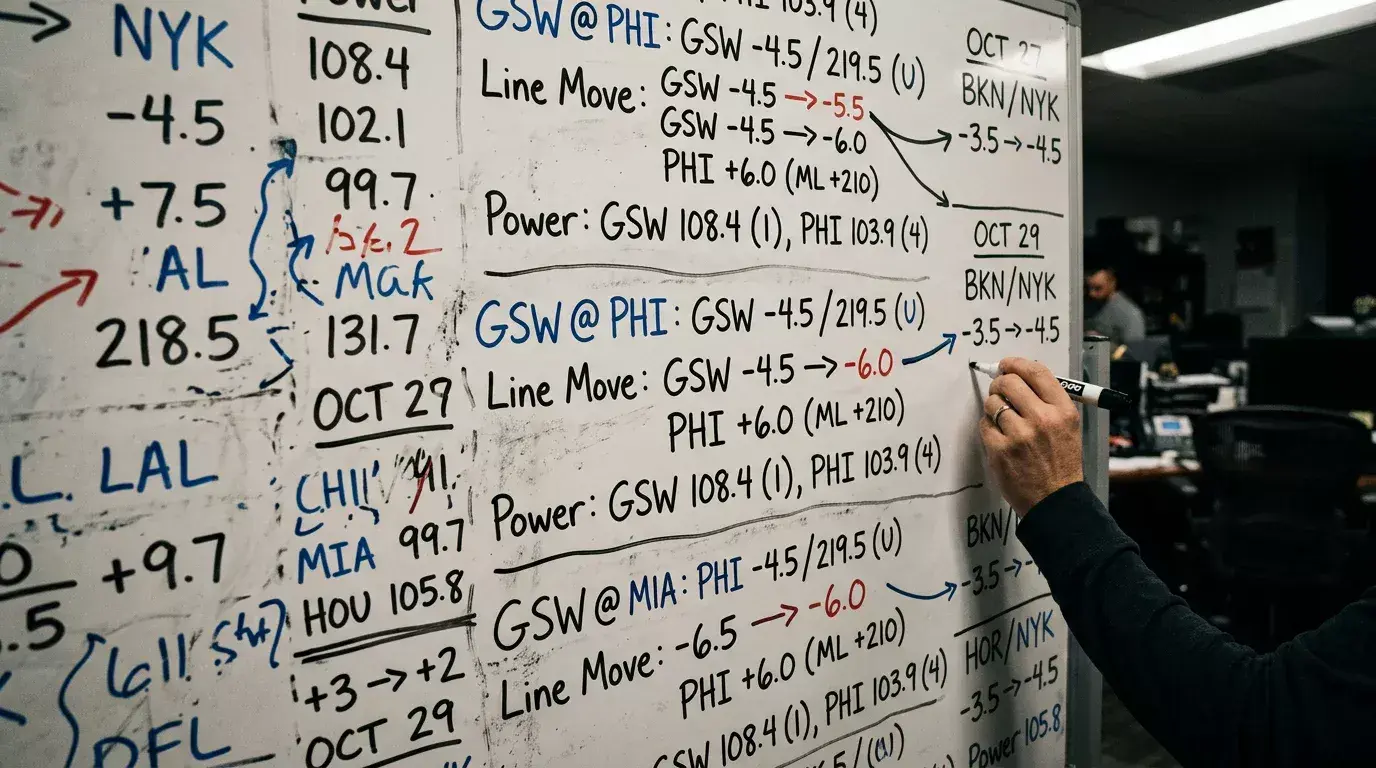
For two years I treated the opening spread as a black box — a number that appeared on my screen with no discernible origin. I would compare it to my own estimate, decide whether I thought the bookmaker was wrong, and place the bet. What I never considered was how that number came to exist in the first place. Once I started understanding the line-setting process, I stopped asking “is this line wrong?” and started asking a better question: “who has already moved this line, and why?” The difference transformed my approach from reactive guesswork to structured analysis.
Power Ratings Formulas: Calculating Bookmaker Opening Spread Lines
Every basketball spread starts with a power rating — a numerical score assigned to each team that represents their overall strength. Bookmakers maintain proprietary power-rating systems that account for offensive and defensive efficiency, pace, roster construction, recent form, and dozens of other variables. The opening line for any game is, at its core, the difference between two power ratings, adjusted for home-court advantage.
Oklahoma City Thunder led the NBA in 2025-26 with a point differential of +11.29 per game. A team with that kind of differential carries a high power rating, which means their opening lines as favourites will be large — often double digits against weaker opponents. The bookmaker does not set that number based on gut feeling. It comes from a model that ingests hundreds of data points and outputs a spread that the bookmaker believes reflects the true expected margin.
The opening line is not the bookmaker’s final opinion. It is a starting point, deliberately designed to attract early betting action that will reveal whether the market agrees with the model. Think of the opening line as a hypothesis. The bookmaker publishes it, watches how bettors respond, and adjusts accordingly. If the hypothesis is close to correct, the line barely moves. If it is off, the market corrects it — and the bookmaker learns something about how its model diverged from collective market intelligence.
What surprises most bettors is that the opening line is often set by a small number of originating bookmakers — sometimes called “market makers” — and other operators copy or shade those numbers rather than building their own from scratch. In the UK, the opening NBA lines you see at major bookmakers frequently originate from the same handful of offshore or US-based market-making firms. The variation between operators at open is minimal; the variation at close, after hours of market activity, is where the meaningful differences emerge.
Market Forces: How Sharp and Public Money Shapes the Spread
I once watched a line move from -6 to -8 in under twenty minutes on a Tuesday afternoon. No injury news had dropped. No lineup change was announced. The shift was entirely driven by money — specifically, by sharp bettors who believed the opening number was too low and hammered the favourite before the public had a chance to react. That two-point move happened because the bookmaker recognised the action as informed and adjusted the line to limit further exposure.
Tony George, a veteran handicapper, puts it bluntly: “We are betting numbers, not teams.” That philosophy is central to understanding line movement. The bookmaker does not care which team wins. They care about balancing their book — ensuring roughly equal money on both sides — and about protecting themselves against sharp action that signals a mispriced line. When a syndicate of professional bettors places coordinated wagers on one side, the bookmaker moves the line to discourage further sharp money and attract public money on the opposite side.
Public money — bets from recreational punters — tends to arrive later, closer to tip-off, and gravitates toward favourites, home teams, and popular franchises. William Hill captures 37.83% of PPC clicks in UK sports betting, with Bet365 at 16.2%, and the betting patterns at these operators often reflect this public bias. When the line moves in the direction of public money, it is usually a routine adjustment to balance the book. When the line moves against the public side — when 70% of bets are on the favourite but the line drops from -7 to -6 — that is a strong signal of sharp action on the underdog.
The interplay between sharp and public money creates the line’s trajectory from open to close. Early moves are typically sharp-driven. Late moves, in the hours before tip-off, are more often public-driven. Understanding this timeline helps you identify when the line is being shaped by information (early) versus volume (late), and which direction offers more reliable signals about the game’s true probability.
Closing Line Value: Why the Final Number Matters
If there is one metric that separates profitable handicap bettors from the rest, it is closing line value (CLV). The concept is simple: did you place your bet at a better number than the closing line? If you took a favourite at -6 and the line closed at -7, you got a full point of CLV. Over hundreds of bets, consistently achieving positive CLV is the strongest predictor of long-term profitability — stronger than ATS record, stronger than ROI over short samples, stronger than any single-game outcome.
The reason CLV matters so much is that the closing line is the market’s best estimate of the true probability. It has been shaped by all available information, all sharp money, all public money, and the bookmaker’s own adjustments. Beating that number means you captured value that the market had not yet priced in at the time of your bet. If you consistently beat the closing line, you are, by definition, ahead of the market — and being ahead of the market is the only sustainable source of edge in spread betting.
Tracking your own CLV requires discipline. For every bet, record the line at which you placed the wager and the line at which the game closed. After fifty or a hundred bets, calculate the average difference. If your average CLV is positive — even by half a point — you are doing something right, regardless of whether your recent results look impressive. Conversely, if your CLV is consistently negative, no streak of lucky wins will save you in the long run.
The practical implication for UK punters is timing. If you bet early, before the sharp action shapes the line, and your read on the game aligns with how the sharps subsequently move the number, you capture CLV naturally. If you bet late, after the line has already incorporated all available information, you are getting the market’s final consensus — and your edge, if any, is slim. For a deeper understanding of how basketball handicap odds work across different formats, the odds guide covers the mechanics of reading and comparing numbers at UK bookmakers.